Publication: Comparative vulnerability of riverine benthic and aquifer stoneflies as the climate warms
Publication: Comparative vulnerability of riverine benthic and aquifer stoneflies as the climate warms
Fri, Oct 02 2026
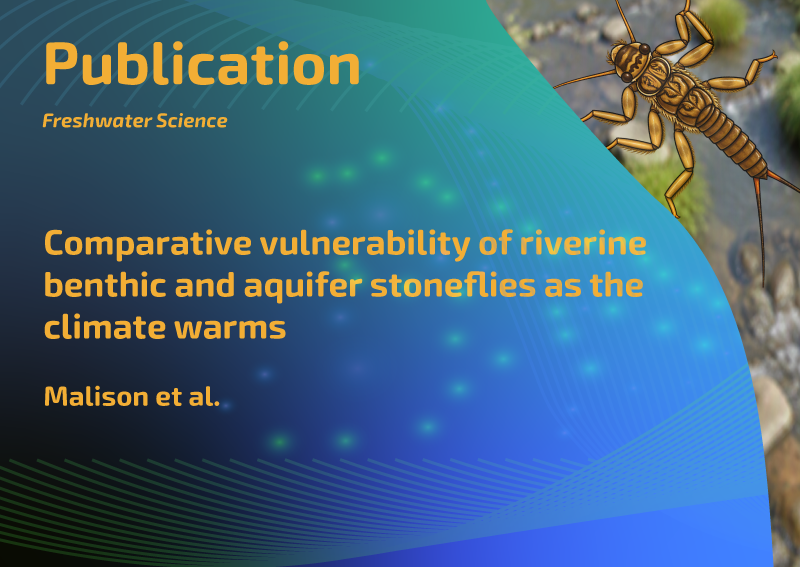
A recent study from Rachel L. Malison and colleagues at the University of Montana published in Freshwater Science investigated how stoneflies living in thermally stable alluvial aquifers and more variable benthic surface waters differ in their physiological responses to increasing temperatures. The work addresses an important question for freshwater ecology: does exposure to different levels of natural temperature variation influence how species cope with warming?
River floodplains provide a particularly interesting system for studying this question. Benthic stoneflies living in surface waters experience substantial daily and annual temperature fluctuations, while stoneflies inhabiting alluvial aquifers spend much of their lives in comparatively stable groundwater. According to the climate variability hypothesis, species evolving under stable conditions may develop narrower thermal tolerances, potentially making aquifer species more sensitive to warming.
To investigate this, the researchers compared five benthic and three aquifer stonefly species collected from three river floodplains in Montana. Rather than relying on a single measure of thermal tolerance, they combined critical thermal maximum (CTMAX) measurements with metabolic rate across increasing temperatures.
Central to the metabolic measurements was an 8 chamber Loligo Systems resting respirometry system. Individual stoneflies were placed in glass respirometry chambers, where oxygen consumption was measured using optical oxygen sensors and AutoResp software. Intermittent respirometry measurements were performed at nine temperatures ranging from 6°C to 30°C, providing metabolic profiles across the thermal range.
The results showed a clear difference in acute thermal tolerance. Benthic stoneflies had CTMAX values approximately 5°C higher than aquifer species, suggesting that species accustomed to greater temperature variability may tolerate acute warming better.
However, the respirometry experiments revealed a more nuanced picture. Despite their difference in CTMAX, aquifer and benthic stoneflies showed surprisingly similar metabolic responses as temperatures increased. There was no clear difference between the groups in the temperature at which metabolic rates peaked or in the breadth of their metabolic performance curves.
The study highlights why multiple physiological measurements are important when assessing climate vulnerability. CTMAX provided a clear indication that aquifer stoneflies were more sensitive to acute warming, while respirometry showed that the metabolic responses of the two groups were considerably more similar. Taken together, these measurements provide a more complete understanding of how different freshwater species may respond to rising temperatures.
The paper, “Comparative vulnerability of riverine benthic and aquifer stoneflies as the climate warms,” was published in Freshwater Science and can be found online at https://doi.org/10.1086/742841
Do you want to learn more about the respirometry tools used in this paper?